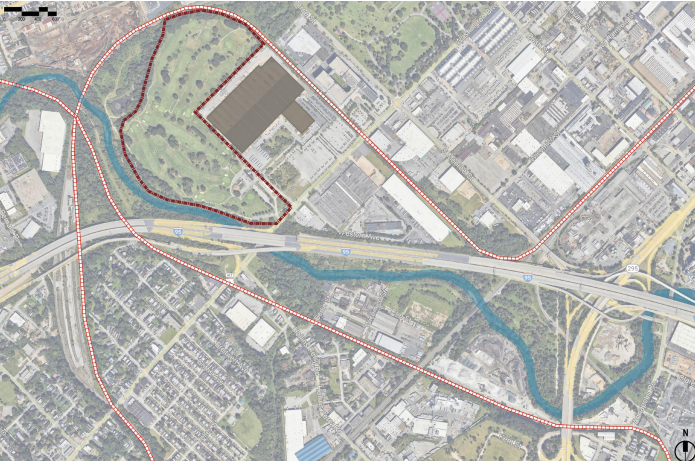
A plan to bring professional outdoor soccer and a new stadium to Baltimore is now focused on the Carroll Park Golf Course in Pigtown. Last week, D.C. United Owner Jason Levien announced the plan to build a stadium and soccer academy for a Major League Soccer (MLS) Next Pro team at the site of the South Baltimore golf course.
MLS Next Pro is the third tier of professional soccer in the United States. D.C. United’s top team competes in MLS.
D.C. United is also looking to launch a USL Super League women’s team in partnership with Baltimore-native and NBA Hall of Famer Carmelo Anthony. This team would also use the proposed new 7,500-seat stadium.
The plan is backed by Baltimore Mayor Brandon Scott and District 46 State Delegate Market Edelson. From the Sports Business Journal:
Scott’s endorsement follows legislation introduced Tuesday by State Delegate Mark Edelson that would authorize the Maryland Stadium Authority to issue up to $216.6M in bonds to finance the project’s acquisition and construction, with debt service paid from state sports wagering revenue. DC United co-owner Jason Levien told SBJ the total project cost, including launching the academy and pro teams, would exceed $300M and that the club’s contribution would be approximately $100M.
The Baltimore Peninsula Development was also eyed for the stadium, but the land where the stadium was proposed is no longer in the hands of the development team. This land currently belongs to Bank OZK, which is looking to sell the land to a new developer.
Previously the Maryland Stadium Authority (MSA) conducted a two-phase soccer stadium study which named Carroll Park Golf Course and Baltimore Peninsula the two best options in terms of stadium sites. The Second phase of the study cost 450,000 and was paid for by D.C. United ($225,000), Maryland Department of Commerce ($140,000), City of Baltimore ($100,000), and MSA ($25,000). Moody Nolan was the prime architect on the study and Pendulum Studio LLC was the associate architect.
The study looked at the possibility of a 7,500-seat stadium and a 12,000-seat stadium with options for canopies above the east and west stands. It also looked at adding an additional 13,746 sq. ft. building next to the training field for the academy with additional locker rooms, training rooms, and offices.
According to the study, a stadium at Baltimore Peninsula would range in cost from $188,751,000 to $221,102,000. A stadium at Carroll Park would range in cost from $216,631,000 to $249,699,000.
At Carroll Park, the proposed new soccer stadium, training field, and parking lots would replace the 60-acre golf course. The stadium would run northwest to southeast, with a training field and building above the northwest side of the stadium. Most of the remaining part of the golf course would be filled with parking lots.
Carroll Park is an active nine-hole golf course adjacent to the Pigtown neighborhood. It was constructed in 1923 and became one of the first racially-integrated golf courses in 1951. It is also adjacent to a Civil War encampment and has a “high probability for precontact and historic archaeological resources.”
From the Sports Business Journal:
The stadium would be expandable to up to 25,000 if needed in the future, with Levien expressing hope that Baltimore could one day become an MLS market.
Also from the article:
“We think [Baltimore] is a robust soccer market commercially and also talent wise, athletically,” Levien said. “One of the unique things that we see about DC United is that we’ve got this territory that includes two municipalities exclusively, and there aren’t too many teams I can’t think of that have that opportunity. Baltimore is a different and distinct market from D.C., and it’s a robust one and one we’re really bullish on.”
From Baltimore Business Journal:
The vision that Levien laid out on Thursday, however, is a much larger project than what the team initially studied. D.C. United wants to build a 40,000-square-foot building equipped with classrooms, a weight room, locker rooms and a cafeteria for soccer prospects. The academy would be privately funded and Levien said he’d eventually like to include some commercial development as part of the project, too.
Also in the article:
“Our long-term vision is to also put residential housing there so we can host tournaments and events, have people living there, and we can bring more people together in the community,” Levien said.
Also in the article:
The Maryland Stadium Authority, however, is already facing a funding crunch. The state has spent billions of dollars on bonds for sports stadiums in recent years, including $600 million each on M&T Bank Stadium and Oriole Park at Camden Yards, $300 million for various minor league stadiums, and $400 million to demolish and rebuild Pimlico Race Course. Department of Legislative Services Analyst Patrick Frank said at a Stadium Authority budget hearing last week that the state lottery fund, which backs those bonds, is already at risk of a credit downgrade.
From The Baltimore Banner:
“I’m kind of speechless,” said Casey O’Neill, president of Citizens of Pigtown.
Friends of Carroll Park is “opposed to the stadium being built at the historic” site, President Camille Greaney said.
Kim Lane previously met with United officials when she was the executive director of Pigtown Main Street. On Thursday, she pointed to Swann Park, a smaller site, as a better option, and said sporting venues do not necessarily provide a massive economic boost to local businesses.
“The games do not have the large impact that people think,” she wrote in a text message.
The stadium renderings from the study show a lower and upper deck on the west sideline, a single-deck bleacher on the south endline, the option for one or two decks of seating on the east sideline, and a video board and standing-room seating on the north endline. There are also party decks in the northeast and northwest corners of the stadium, and suites and a press box on the west side of the stadium.
Carroll Park Golf Course is not currently close to rail transportation. Regional access to the Carroll Park site is provided via I-95, MD 295, and US 1.
According to the study, the reason the cost estimates are lower at Baltimore Peninsula is because “Carroll Park Golf Course site requires significant grading, site improvements, and parking due to the location, and the public parking for the Peninsula site will be developed off-site.”
Phase 1 of the study selected Carroll Park Golf Course, Reedbird Park in Cherry Hill, and Swann Park as the top three sites for a stadium. Swann Park was swapped out for Baltimore Peninsula after it was determined not to be a viable option due to a large easement between the City of Baltimore and Baltimore Gas & Electric at the site, which made the available land too small for a stadium.
Images courtesy of the Moody Nolan Study