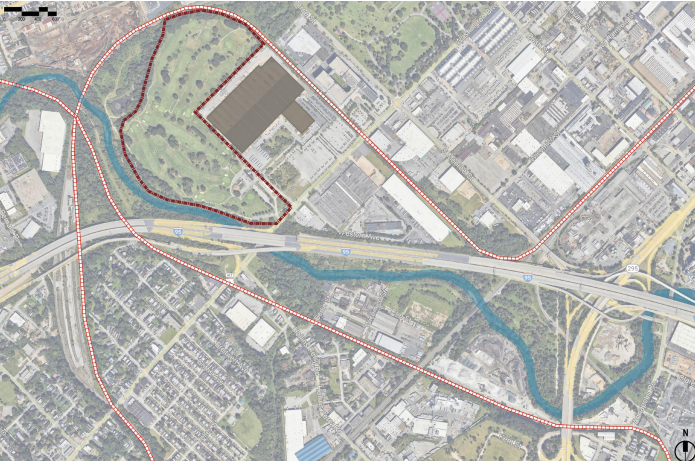
A plan by D.C. United to bring professional outdoor soccer, a new stadium, and a youth academy to the Carroll Park Golf Course in Pigtown failed to secure any funding in 2026 Maryland General Assembly. Legislation was introduced by District 46 State Delegate Mark Edelson and District 40 Senator Antonio Hayes to issue up to $216.6M in bonds to finance the project’s acquisition and construction, but this failed to make it out of committee in both the Maryland House and Senate.
The 7,500-seat stadium plan is for a Major League Soccer (MLS) Next Pro team. MLS Next Pro is the third tier of professional soccer in the United States. D.C. United’s top team competes in MLS.
D.C. United is also looking to launch a USL Super League women’s team in partnership with Baltimore-native and NBA Hall of Famer Carmelo Anthony. This team would also use the proposed new stadium.
From The Baltimore Banner:
“When we introduced the legislation, the purpose was not to get it funded,” Sen. Antonio Hayes, who sponsored the bill, said in an interview. “The purpose was to keep the conversation going.”
Samantha Ward, a D.C. United spokesperson, said the club would continue its work to bring pro soccer to Charm City.
“We remain actively engaged with state and local leadership to advance a sustainable funding strategy and carry this momentum forward, confident in the alignment behind bringing this project to life,” Ward wrote in an email.
Also in the article:
“There’s some serious community opposition,” Hayes, a West Baltimore Democrat, said. “I think there’s still [an] ample amount of time to have discussions to see if they would be open to it, but I don’t think it’s my job to convince them.”
That’s D.C. United’s job, Hayes said. Officials with the team told lawmakers in early March they were committed to honoring the course’s legacy. Any development, however, would mean the end of the golf course, which has some of the lowest greens fees in the region.
In a statement to WTOP, Edelson said while the bills have not moved so far, there is still time in the legislative session to get something done. However, if the bills are not successful, conversations will continue to bring “this transformative project to life.”
“This is a very big and ambitious project that is going to require significant community input to make sure we get it just right, so as to maximize the significant investment and potential the project represents,” Edelson said.
Baltimore City Mayor Brandon Scott was a vocal backer of the project at a press event in February.
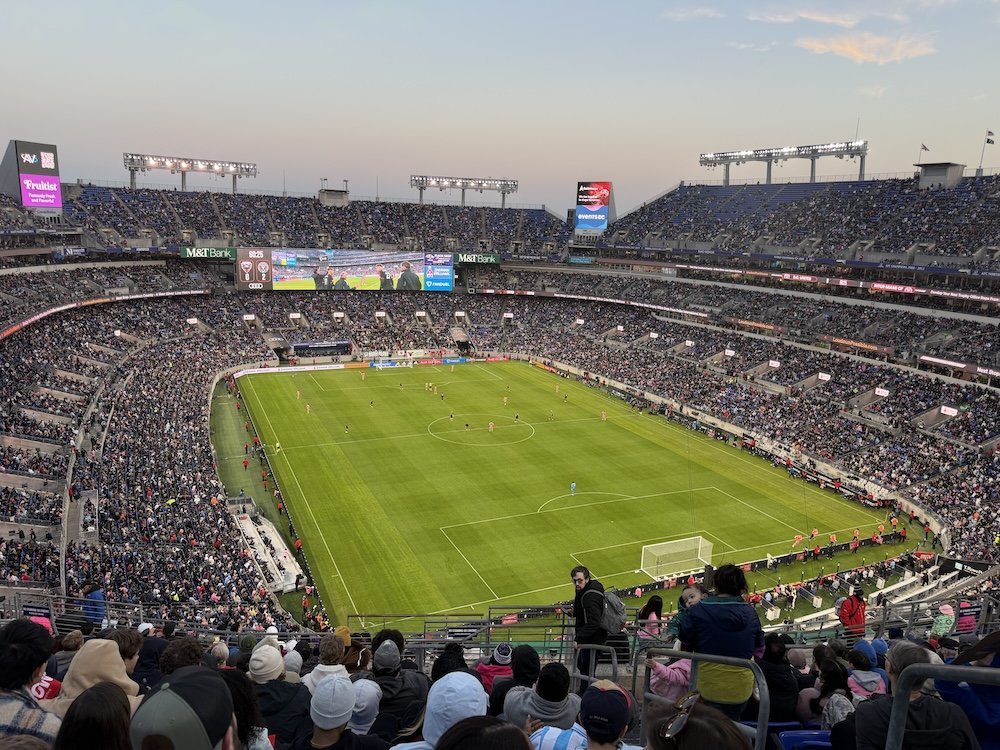
D.C. United’s MLS squad hosted Lionel Messi’s Inter Miami CF on March 7th at M&T Bank Stadium in front of an announced crowd of 72,026.
The Baltimore Peninsula Development was also eyed for the stadium, but the land where the stadium was proposed is no longer in the hands of the development team. This land currently belongs to Bank OZK, which is looking to sell the land to a new developer.
Previously the Maryland Stadium Authority (MSA) conducted a two-phase soccer stadium study which named Carroll Park Golf Course and Baltimore Peninsula the two best options in terms of stadium sites. The second phase of the study cost $450,000 and was paid for by D.C. United ($225,000), Maryland Department of Commerce ($100,000), City of Baltimore ($100,000), and MSA ($25,000). Moody Nolan was the prime architect on the study and Pendulum Studio LLC was the associate architect.
The study looked at the possibility of a 7,500-seat stadium and a 12,000-seat stadium with options for canopies above the east and west stands. It also looked at adding an additional 13,746 sq. ft. building next to the training field for the academy with additional locker rooms, training rooms, and offices.
According to the study, a stadium at Baltimore Peninsula would range in cost from $188,751,000 to $221,102,000. A stadium at Carroll Park would range in cost from $216,631,000 to $249,699,000.
At Carroll Park, the proposed new soccer stadium, training field, and parking lots would replace the 60-acre golf course. The stadium would run northwest to southeast, with a training field and building above the northwest side of the stadium. Most of the remaining part of the golf course would be filled with parking lots.
Carroll Park is an active nine-hole golf course adjacent to the Pigtown neighborhood. It was constructed in 1923 and became one of the first racially-integrated golf courses in 1951. It is also adjacent to a Civil War encampment and has a “high probability for precontact and historic archaeological resources.”
The stadium renderings from the study show a lower and upper deck on the west sideline, a single-deck bleacher on the south endline, the option for one or two decks of seating on the east sideline, and a video board and standing-room seating on the north endline. There are also party decks in the northeast and northwest corners of the stadium, and suites and a press box on the west side of the stadium.
From the Sports Business Journal in February:
The stadium would be expandable to up to 25,000 if needed in the future, with Levien expressing hope that Baltimore could one day become an MLS market.
Carroll Park Golf Course is not currently close to rail transportation. Regional access to the Carroll Park site is provided via I-95, MD 295, and US 1.
According to the study, the reason the cost estimates are lower at Baltimore Peninsula is because “Carroll Park Golf Course site requires significant grading, site improvements, and parking due to the location, and the public parking for the Peninsula site will be developed off-site.”
Phase 1 of the study selected Carroll Park Golf Course, Reedbird Park in Cherry Hill, and Swann Park as the top three sites for a stadium. Swann Park was swapped out for Baltimore Peninsula after it was determined not to be a viable option due to a large easement between the City of Baltimore and Baltimore Gas & Electric at the site, which made the available land too small for a stadium.
Baltimore Business Journal reported last month that Coppermine is planning to convert the former Cardinal Gibbons High School in Southwest Baltimore into a soccer academy and a home field for its team which will compete in the ML Next Homegrown division.
D.C. United vs. Inter Miami CF at M&T Bank Stadium
Images courtesy of the Moody Nolan Study