

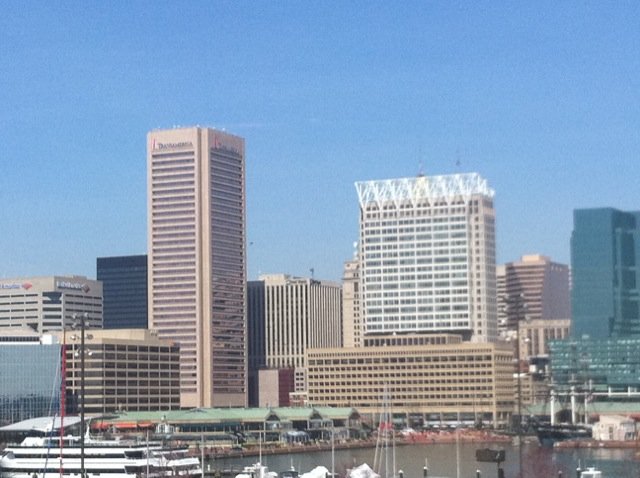
 We’ve spent a lot of time on SouthBMore.com breaking down the future of Downtown and the Inner Harbor and with today’s release of the State of Downtown Report, we have a lot more information to cover. Our downtown is officially the one-mile radius from Light and Pratt St., which includes Center City, Westside, Harbor East, Federal Hill, Mt. Vernon and other surrounding areas.
I described downtown, specifically Center City, as “the place where vibrancy dies on Charles St. between Inner Harbor and Mt. Vernon.” A lot of wheels are now in motion to change that aspect of our city’s central business district. Westside has a whole different type of vibrancy that the city is working hard to get rid of!
I’ve always said that the most important thing City Center can do to keep up with their Federal Hill, Mt. Vernon and Harbor East neighbors is add more residents. Workers fill the area up during the day, but when 66% of them leave for the surrounding counties at 5pm every day it creates a ghost town in the shadows of the big buildings on nights and weekends – the time when everyone is off of work and exploring our great city!
The problem is not convincing people to move downtown, the problem is available residential units for them to occupy. Our downtown population grew once again from 41,289 in 2010 to 42,011 as a new apartment building was added (Saratoga Loft Apartments) and new condos were sold, including 35 units at Ritz Carlton Residences (average sale price of $985,000.) Baltimore’s downtown population is 8th best in the nation, ahead of cities like Washington, DC, Atlanta and Houston. Downtown Partnership has also created an open-space master plan to create a more livable downtown, highlighted by a Millennium Park-type feel for the soon-to-be old First Mariner Arena site.
 Currently apartment buildings downtown carry a 97.2% occupancy rate, up from 96% in 2010. Five apartment buildings ranging in sizes are currently under construction and the Mechanic Theatre redevelopment, which will be heavily residential, will be starting very soon. Downtown Partnership is working hard to persuade under-used office building owners the need for additional housing downtown. Downtown’s population has grown 14% since 2000 and Westside/City Center has grown 130% since 2000.
Downtown’s retail vacancy rate stands at 5.7% compared to 6.6% in the metropolitan region and 9.9% nationally. Looking at the raging success of retail in Harbor East, Mt. Vernon and Federal Hill, the number is not a surprise, but it does not underscore where many of the vacancies do exist, Center City and Westside. Once again more residents will lead to more vibrancy, which will lead to less vacant store fronts in Center City and Westside. Many new stores and businesses are also about to open around the Inner Harbor, which will really boost downtown retail.
It was a win/lose year for office space downtown in 2011. The office occupancy rate grew from 80.8% to 82.3%. This was highlighted by lease transactions from BB&T, Transamerica, PNC and Miles & Stockbridge. Despite new occupancy, the total number of jobs downtown dropped 9.4% from 113,437 jobs in 2010 to 102,731 jobs in 2011. Most metropolitan downtowns across the U.S. had similar results. Baltimore retained its #15 spot for employment density.
Two new hotels opened in 2011 – the boutique Inn at the Black Olive in Fell’s Point and the 256-room Four Seasons Hotel Baltimore in Harbor East. These new rooms brought the number of hotel rooms to 8,135. Downtown hotels enjoyed better occupancy (63%), average daily rates ($146.93) and revenue per available room ($92.58) than the Baltimore metropolitan area and the nation as a whole.
Westside should be very intriguing to watch over the next couple years. It is a priority of Mayor Rawlings-Blake and the University of Maryland to clean up the western section of Downtown Baltimore. The southern portion of Westside is highlighted by a burgeoning arts district spurred by the Hippodrome and the soon-to-come Everyman Theatre on Fayette St., in addition to many new apartment buildings. The northern portion, though, still needs a lot of work.
 Highlighted by the Lexington Market, the northern portion of Westside took its first steps towards cleaning up the area around market, but it resulted in a big blow to SoWeBo. The Walter P. Carter Clinic, housing many drug treatment and Methadone patients, will be torn down and 700 patients have been moved to 1101 West Pratt Street in SoWeBo. The Southwest Partnership formed a group to fight this move as they were infuriated by zero community involvement involved in this move.
“They didn’t even have the courtesy to work with the community associations. No one is against treatment programs, but this clustering of services is unhealthy for the neighborhood and is unjust,” said Jane Buccheri, President of Hollins Roundhouse. Southwest Partnership is meeting with University of Maryland tonight, the first meeting between the two groups.
Downtown Partnership of Baltimore is eyeing a redevelopment of Lexington Market to create more open space with the removal of unneeded space at the market. Baltimore City Police and University of Maryland security are also working very hard to change the image of a once proud place of Baltimore, which is now known as a great place to score drugs.
Update: Southwest Partnership met with University of MD last night, and UMD did confirm that they were evicted from Westside and the decision of where they could go was above their authority (State/City Leaders).
Another huge project for Westside will be the Super Block, just across the street from the new Everyman Theatre. The Super Block is proposed to become 312,595 sq. feet of retail space, 400 apartments and 925 parking spaces. They are hoping to move forward with development very soon. Stalled by the recession, civil rights activists, the Historical and Architectural Preservation and lawsuits, the Super Block and Baltimore City is hoping to win an appeal in federal court that will move this project forward. If they don’t win, the project will likely fall apart.
Update: Baltimore Brew is reporting that the Superblock may be very close to a reality…. 10 years later.
We’ve seen highs and lows for downtown, but the best news that could come is the decision of more Class B and C office building owners to make the conversion to residential. But hopefully these owners won’t get a significant tax break for these high-demand buildings as the rest of us working class people suffer with the 2.26 property tax rate.
